Common Misconceptions in Selecting Large-Diameter Hoses: Focusing Only on Draw Diameter, Ignoring Op
Many engineering companies easily fall into a simplistic selection trap when purchasing large-diameter industrial hoses: only checking the hose's inner diameter and unit price, assuming that as long as the diameter meets the standard, it will be suitable for all operating conditions. However, in actual use, this hasty selection often creates numerous safety hazards: choosing a hose with a smooth inner layer for conveying highly abrasive slurry will cause the inner layer to wear through in a short time; choosing a product with low reinforcement levels for high-pressure pumping will lead to bulging and bursting after a short period of operation; neglecting the outer layer's weather resistance for long-term outdoor use will result in cracking of the outer rubber layer within just a few months. While seemingly saving a little on procurement costs, it can ultimately lead to the entire project line being shut down due to sudden failures, resulting in a comprehensive cost far exceeding expectations.
Core Performance Dimensions Breakdown: Selecting the Right Product for the Operating Conditions
To select a large-diameter industrial hose that is truly suitable for the operating conditions, simply looking at the draw diameter is far from enough. It is necessary to check it one by one from three core dimensions. First, the inner layer material should be selected based on the medium being transported: for highly abrasive materials such as mud and sand, a thickened inner layer with high wear resistance is preferred; for weak acids, alkalis, and chemical media, a corrosion-resistant special material inner layer should be selected; for food-grade media, an inner layer material meeting food contact safety standards should be chosen. Second, the reinforcement skeleton layers should be selected based on the actual working pressure, with the appropriate number of steel wire winding or fiber braiding layers, and a safety redundancy of 1.5-2 times reserved to prevent overpressure bursts during operation. Third, the outer layer protection should be chosen for special environments such as outdoor exposure to sunlight, oil contamination, and extreme low temperatures, selecting a weather-resistant, oil-resistant, and low-temperature-resistant outer layer formula to ensure the hose's service life in complex environments.
Customized connectors and assemblies enable rapid on-site connection.
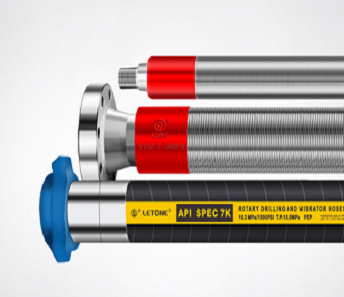
Qualified large-diameter industrial hoses are often not delivered as bare pipes, but rather pre-assembled with flanges, quick couplings, and other connectors according to the requirements of on-site equipment interfaces, delivering complete hose assemblies directly. During production, the factory matches the hose's diameter and pressure rating with appropriate strength fittings, using a professional crimping process to ensure a firm connection between the fitting and the hose body. This avoids problems like fitting detachment and leakage that can easily occur during on-site assembly. After receiving the finished product, users can simply bolt the flange to the on-site equipment to quickly complete the pipeline installation, eliminating the need for additional processing equipment and significantly reducing on-site installation barriers and time costs.
Lifecycle Cost Accounting: Rejecting the Trap of Low Price and Low Quality
Many people, when calculating the cost of large-diameter industrial hoses, only compare the purchase price per unit, neglecting lifespan and failure losses. Low-priced, low-quality large-diameter hoses may wear through or burst after only a few weeks of use, requiring repeated replacements and incalculable project delays due to downtime. In contrast, compliantly manufactured industrial-grade large-diameter hoses, when correctly selected and used according to regulations, can have a lifespan of several months or even years. In the long run, the cost per unit of use is far lower than that of low-priced, low-quality products. Nowadays, more and more engineering companies are abandoning the idea of "only comparing unit prices" and turning to comprehensive cost accounting throughout the entire life cycle, choosing compliant and stable industrial-grade large-diameter hoses to reduce hidden losses caused by pipeline failures from the root.
 English
 Turkish
 Dutch
Dutch Greek
Greek English