Common Selection Mistakes: Focusing Only on Diameter and Pressure, Ignoring Pulse Fatigue and Media
Many drilling teams, when purchasing high-pressure drilling mud hoses, habitually only check two numbers: inner diameter and working pressure, and immediately deploy them to the well if they meet the standards. However, in actual operation, this simplified selection often introduces hidden dangers: ignoring fatigue wear caused by pressure pulses, leading to premature fatigue fracture of the reinforcing layer under frequent pressure fluctuations; ignoring the compatibility of the inner layer material with the mud medium, causing the inner layer to swell and bubble due to oil-based mud; ignoring the compatibility of the connector type with the field equipment, resulting in forced on-site connection and seal failure. By the time a sudden pipe burst occurs on the well and the cause is found, the damage is already irreparable. The true first step in selection is not looking at the parameter table, but clarifying the actual operating conditions of the hose.
Checking Four Dimensions One by One, Matching Parameters to the Field
Selection can be confirmed item by item from four dimensions. The first is pressure rating matching: select the specification corresponding to the actual maximum pump pressure of the mud pump, leaving a reasonable safety margin to avoid long-term operation at pressures close to the limit. Secondly, media compatibility is crucial. The appropriate inner layer formulation should be selected based on whether the pump is water-based, oil-based, or cementing slurry. If necessary, materials with stronger oil and chemical resistance should be used. Thirdly, temperature adaptability is essential. Well site environments have large temperature ranges, so it's necessary to confirm that the hose's applicable temperature range can cover the extreme high and low temperatures of the operating area. Fourthly, flexibility and bending radius are critical. The top drive connection section requires frequent bending, so a specification with better flexibility and a smaller minimum bending radius should be selected to avoid fatigue damage to the reinforcing layer caused by prolonged bending.
Integrated joint delivery eliminates weak points in field connections.
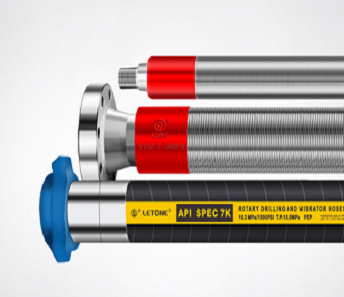
A significant proportion of hose failures in the field are not due to the hose body, but rather to the joints. Temporary binding with clamps and wires in the field is prone to slippage and leakage under high-pressure pulse conditions. The standard practice is to complete the crimping assembly of the entire hose assembly (union or flange) in the factory according to the field equipment interface standards, delivering a complete hose assembly that can be directly connected. Standardized crimping processes ensure consistent and stable joint strength between the joint and the hose body. Static pressure and burst tests are performed on each hose before leaving the factory, preventing defective products from being shipped. On-site installation can be completed simply by tightening according to the torque specifications, avoiding the risks of improper installation and significantly reducing downtime for installation.
Lifecycle accounting: Reliability is more valuable than unit price
When calculating the cost of drilling mud hoses, comparing only the purchase price per hose often leads to incorrect conclusions. Low-priced hoses may experience fatigue failure after only a few operating cycles, requiring repeated purchases and drilling stoppages for replacement, compounding downtime and safety risks, making the actual cost far higher than a compliant product. Hoses manufactured according to standards and properly matched to operating conditions can serve stably for a longer period under standardized use, resulting in lower consumable costs per operating cycle. For the drilling industry, where downtime costs are extremely high, hose price is never the most weighted factor in procurement decisions.
 English
 Turkish
 Dutch
Dutch Greek
Greek English