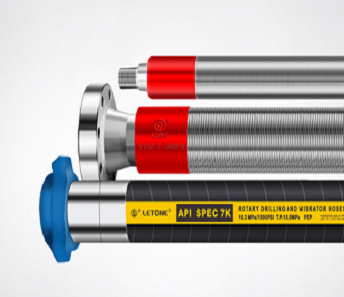
Common Selection Misconceptions: Using Ordinary High-Pressure Hoses as Vibration-Damping Hoses
Many drilling sites fall into a typical misconception during procurement: believing that "as long as the high-pressure hose has sufficient pressure resistance, it will provide vibration damping," and directly install ordinary high-pressure drilling hoses at the pump outlet vibration isolation point. However, they find that either the ordinary high-pressure hose's body stiffness is too high, preventing vibration transmission and absorption, leading to cracking; or the hose body is too soft, repeatedly expanding radially under high pressure, not only failing to provide vibration damping but also amplifying pressure pulsations, causing fatigue fracture of the steel wire reinforcement layer after a short period, or even pipe bursting. In reality, the core of vibration-damping hoses is never "the softer the better," but rather a precise match between pressure resistance, pulse fatigue life, and vibration-damping stiffness. Ordinary high-pressure hoses are not structurally optimized for stiffness and cannot replace dedicated vibration-damping hoses.
Four Core Dimensions to Choose the Right Product for Your Working Conditions
When selecting drilling vibration-damping hoses, don't just look at the diameter and working pressure figures; check them one by one from four core dimensions. First, stiffness matching: Select products with the appropriate stiffness level based on the vibration frequency of the piping system on site. This ensures sufficient displacement compensation to absorb vibration while preventing significant bulging and deformation of the pipe body under high pressure. Second, pulse fatigue life: Don't just look at the static burst pressure; confirm the product's resistance to pulse cycles under rated pressure. Three-cylinder pumps operate under high-frequency pulse conditions, and ordinary static pressure hoses simply cannot withstand long-term repeated pressure fluctuations. Third, medium and temperature compatibility: Select the appropriate corrosion-resistant inner layer based on water-based or oil-based mud. In high-altitude and high-temperature desert areas, choose materials with the corresponding temperature resistance level. Fourth, displacement compensation: Confirm the product's allowable maximum axial expansion, lateral offset, and angular deflection to match the actual vibration amplitude and misalignment on site.
Proper installation determines vibration damping effect; don't install hoses like "rigid pipes."
Many times, poor vibration damping performance of hoses is not due to a problem with the product itself, but rather incorrect installation. During some on-site installations, the hoses are stretched perfectly straight, and the flanges at both ends are forcibly aligned without any allowance for deformation. This prevents the hoses from functioning elastically, rendering them indistinguishable from rigid pipes. The correct installation method involves allowing reasonable pre-displacement based on the direction of pipeline vibration, avoiding forced twisting and alignment. The bending radius must not be less than the minimum specified by the product. Rigid supports should not be installed near the ends of the hose to jam the pipe; allow the hose free deformation space to absorb vibration, while avoiding the concentration of additional stress at the joints.
Lifecycle Cost Accounting: Don't Save Small Costs for Big Losses
When calculating the cost of this type of hose, comparing only the purchase price per unit can easily lead to errors. The purchase cost of a single ordinary high-pressure hose is slightly lower, but its vibration isolation effect is poor. Over a year, the hidden costs of repairing rigid pipes, replacing damaged instruments, and emergency drilling shutdowns far exceed the price difference of several hoses. In contrast, compliant drilling vibration damping hoses not only have a longer lifespan against pulse fatigue but also reduce the frequency of failures in the entire piping system, significantly reducing unplanned drilling downtime. For drilling operations where downtime losses can reach tens of thousands of yuan per hour, a specialized hose that can stably isolate vibrations and reduce malfunctions brings comprehensive benefits far exceeding its purchase cost.
 English
 Turkish
 Dutch
Dutch Greek
Greek English