Yóutián zuǎnjǐng de róuxìng liánjiē xūqiú: Zuāntàn jiāoguǎn zài xúnhuán xìtǒng zhōng de zhēnshí dìn
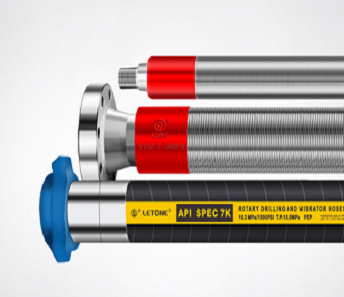
In oilfield drilling sites, drilling hoses are flexible pressure-bearing components connecting the mud pump, manifold, riser, and top drive. They are often referred to in the industry as high-pressure mud delivery hoses. While they appear to be just a small section of the pipeline, they bear the most demanding combination of operating conditions in the entire mud circulation system: inside the hose is high-speed flowing, high-pressure mud carrying large amounts of cuttings; outside, there is the harsh environment of the well site with its wind, sand, sun, and drastic temperature fluctuations; simultaneously, the hose must repeatedly rise, fall, swing, and bend with the top drive. Compared to rigid tubing, its value lies not in bearing pressure, but in "being able to move while bearing pressure"—this flexibility allows stress to be released between rigid tubing strings, vibrations to be isolated, and misalignments to be compensated for. Therefore, although drilling hoses constitute a small portion of the overall drilling equipment system, they directly affect the continuous and stable operation of the mud circulation system.
Multi-layered composite structure, reinforced for each of the four core drilling conditions
The drilling hose features a multi-layered composite directional design, with each layer addressing a specific core challenge. The inner layer uses an oil- and chemically resistant synthetic rubber formula, ensuring it won't swell or delaminate even after long-term transport of water-based mud, oil-based mud, or even cementing slurry. The middle layer, a reinforcing skeleton composed of multiple layers of high-strength steel wire or rope, directly determines the hose's pressure resistance and fatigue life against pressure pulses, making it the most critical load-bearing layer under high-pressure conditions. The outer layer uses a wear-resistant and weather-resistant protective rubber to resist well site sand and gravel friction, UV aging, and occasional oil contamination. The interior maintains a smooth, full-bore design to reduce the deposition of solid particles such as barite, preventing flow rate reduction or even blockage after long-term use. This layered reinforcement targeting high pressure, pulses, wear, and corrosion is the core difference between drilling hoses and ordinary delivery hoses.
Covering the entire well site, from pump outlet to every flexible node at the wellhead
Drilling hoses are adaptable to almost the entire fluid flow path of oilfield drilling. At the mud pump outlet, they absorb high-frequency vibrations and pressure pulsations generated by the reciprocating motion of the plunger, protecting downstream manifolds and instruments; at high-pressure manifold sections, they compensate for displacement stress caused by thermal expansion and contraction of the pipeline and installation errors; between the upper end of the riser and the top drive unit, they follow the repeated up-and-down swinging of the top drive, maintaining a stable seal during dynamic bending; in cementing operations, they serve as a flexible connector in the cementing manifold to deliver high-density cement slurry; and in well control processes such as well kill and well washing, they can also handle the circulating transport of high-pressure media. Different nodes have different requirements for pressure, diameter, flexibility, and wear resistance; therefore, drilling hoses are usually classified into multiple specifications according to pressure ratings, allowing for precise matching on-site based on actual pump pressure and well depth.
Safety Redundancy and Standardized Testing: A Safety Net for High-Risk Operations
Oilfield drilling is a typical high-risk operation. The high pressure and high velocity of the medium inside the pipe mean that a pipe burst could have devastating consequences. Therefore, compliant drilling hoses are designed with ample safety redundancy. The test pressure is typically 1.5 times the working pressure, and the minimum burst pressure can reach 2.5 times the working pressure. The hose body and joints use a one-piece crimped structure to avoid weak points in the seal created by temporary assembly on-site. Each hose undergoes static pressure and burst testing before leaving the factory. For scenarios like well sites where "a single leak is extremely costly," ensuring sufficient pressure margin in the design and robust seals at the connection points is the most practical way to guarantee continuous safe operation.
 English
 Turkish
 Dutch
Dutch Greek
Greek English